



A pilot light usually keeps going out for one of a few reasons: a draught blowing it out, a worn thermocouple that can’t sense it’s still lit, a dirty or partially blocked pilot jet, or a faulty gas valve. Some of these are harmless and easy to deal with, others need a Gas Safe registered engineer to sort properly. The trick is knowing which is which before you keep relighting it over and over.
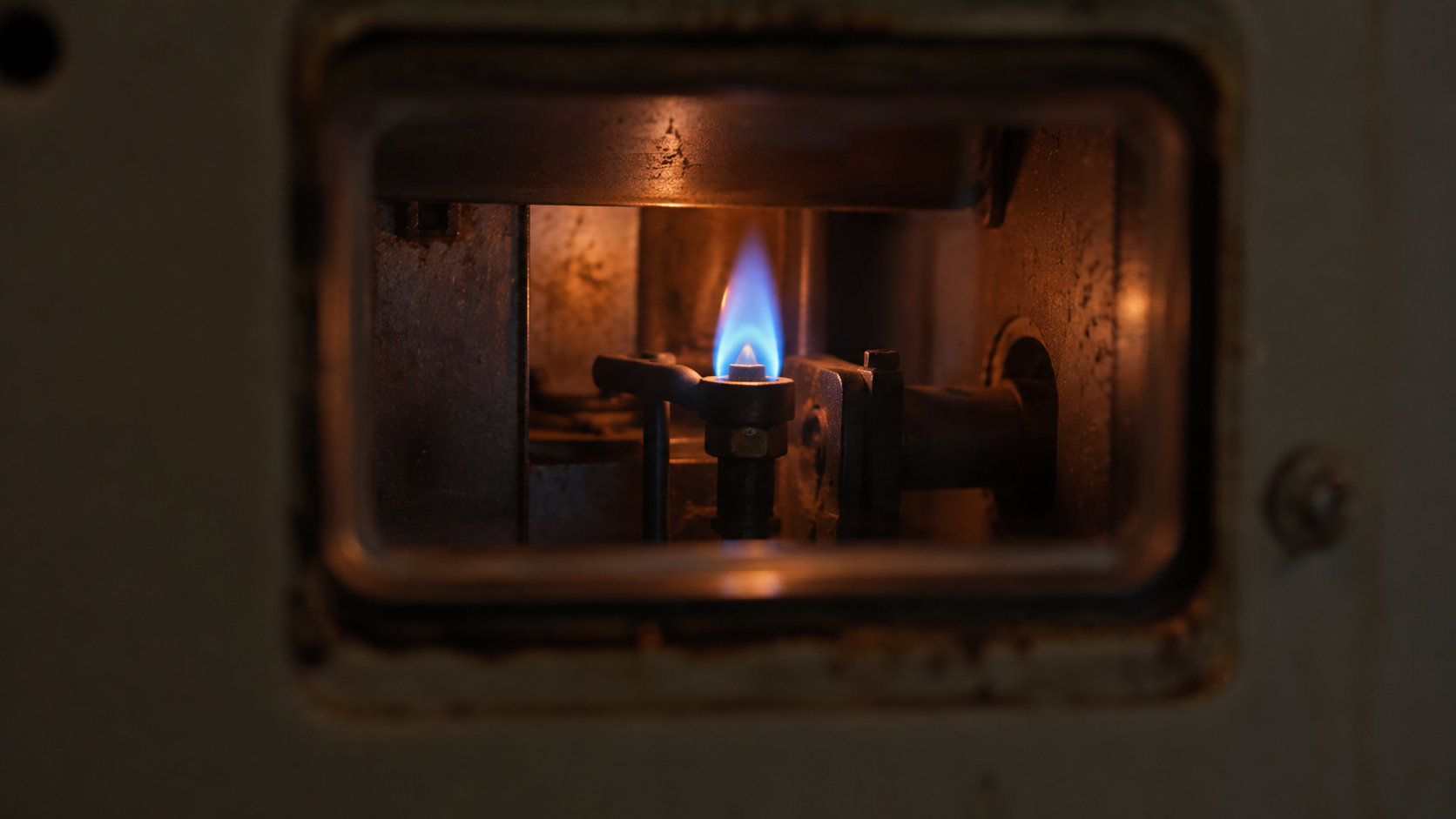
Does my boiler even have a pilot light?
Not every boiler does. Older boilers, particularly ones installed before the mid-2000s, tend to have a standing pilot light that burns constantly, ready to ignite the main burner whenever heating or hot water is called for. Most boilers installed more recently use electronic ignition instead, sparking the burner directly only when it’s needed, with no permanent flame at all.
If your boiler has a small viewing window near the bottom where you can see a little blue flame, that’s your pilot light. If there’s no such window, or nothing burning inside it, your boiler is almost certainly the electronic ignition type, and a “pilot light” issue isn’t what’s causing whatever fault you’re seeing.
Common reasons a pilot light keeps going out
A few faults account for most pilot light problems:
- Draughts blowing the flame out, often from a badly sealed boiler casing or a nearby door or window
- A worn thermocouple, the small safety sensor that detects the pilot flame and shuts off the gas supply if it can’t sense it, even when the flame is actually there
- A dirty or partially blocked pilot jet, restricting gas flow enough that the flame struggles to stay lit
- A faulty gas valve, which can affect gas flow to the pilot as well as the main burner
- A failing thermostat or control board, in less common cases, cutting the signal that keeps the pilot supply open
A pilot that goes out occasionally, especially in a draughty spot, might just need resealing. One that won’t stay lit no matter what, or that goes out within seconds every time, usually points to a thermocouple or gas valve issue.
Can I relight it myself?
Often, yes. Many boilers have a printed relighting procedure on a label inside the casing, written specifically for homeowners to follow, and if yours does, it’s designed to be safe to use exactly as written. It typically involves holding down a control knob, using a built-in igniter or a match, and waiting a set number of seconds before releasing it.
Stick strictly to those printed instructions and don’t improvise. If the pilot won’t stay lit after a couple of proper attempts, if you can smell gas at any point, or if there’s no printed procedure to follow, stop there. That’s the point to call a Gas Safe registered engineer rather than keep trying, since anything beyond simply relighting a pilot using the manufacturer’s own instructions involves gas appliance internals that shouldn’t be touched without the right qualifications.
When a flickering or yellow flame is a warning sign
A healthy pilot flame burns a steady blue. If it’s flickering, or burning yellow or orange rather than blue, that’s worth taking seriously rather than just relighting and moving on. It can point to incomplete combustion, which in turn can be linked to carbon monoxide production.
If you notice a yellow or orange flame, soot or staining near the boiler casing, or your carbon monoxide alarm ever sounds, treat it as urgent. Turn the boiler off if it’s safe to do so, ventilate the room, and get a Gas Safe registered engineer out straight away rather than attempting any further relighting yourself.
When to call a Gas Safe registered engineer
Beyond the warning signs above, it’s worth calling in a professional if the pilot light problem keeps recurring, if you’ve followed the manufacturer’s relighting instructions correctly and it still won’t hold, or if you simply don’t have a printed procedure to follow safely. A recurring pilot fault is also a good prompt to check when your boiler last had a proper service, since a worn thermocouple or dirty pilot assembly is exactly the sort of thing a routine service tends to catch before it becomes a repeated annoyance.
Frequently asked questions
Is it dangerous if my pilot light keeps going out?
Not on its own, but it’s a sign something needs looking at. If the flame ever burns yellow or orange, or it won’t stay lit however many times you try, stop and get an engineer out rather than continuing to relight it.
Can a boiler run without a pilot light?
Yes, most newer boilers do exactly that. Electronic ignition has largely replaced standing pilot lights over the last couple of decades, so a “pilot light” issue mostly applies to older boilers.
How much does it cost to fix a pilot light problem?
It varies depending on the cause, a dirty pilot assembly is usually straightforward, while a thermocouple or gas valve replacement costs more. An engineer can only quote accurately once they’ve seen what’s actually wrong.
Still going out after relighting it?
If you’ve followed the instructions properly and the pilot still won’t hold, or you’ve noticed any of the warning signs above, it’s not worth persisting with it yourself. We help homeowners across Bagshot, Chobham and the surrounding areas get boiler faults like this sorted properly. Get in touch and we’ll take a proper look.